
The dead internet is in my replies... here's what I'm trying
Chris Rupp
Yesterday I published my article on Git, and within minutes the replies started rolling in… more than my last article got, which honestly felt great for about five minutes, right up until I actually read them and realized it was mostly bots replying to a post that a bunch of other bots were probably “reading” too. Bots on bots. So this one isn’t about code really, it’s about the thing every one of us posting stuff online is running into right now, and a few things I’m trying to do about it (SOME answers, definitely not THE answers).
What showed up
The first reply was pure praise… “explaining git in musician terms is genius,” followed by a line about how half the battle is realizing it’s just a save history. Which sounds nice, until you notice it’s basically my own title and my own angle handed right back to me with a compliment stapled on, and nothing in it that you couldn’t get from the headline.
The second one told me the article didn’t load for them, and then a little later, “must be a me problem then.” I’m about 99% sure that’s a bot, cuz the whole point of a reply like that is to get me to answer it, and every answer is a little more reach for the account.
And then there was a genuinely useful tip about running git status -sb for a shorter status view… which is honestly a good tip! But still felt something any of my own agents could have easily done if I gave it that direction.
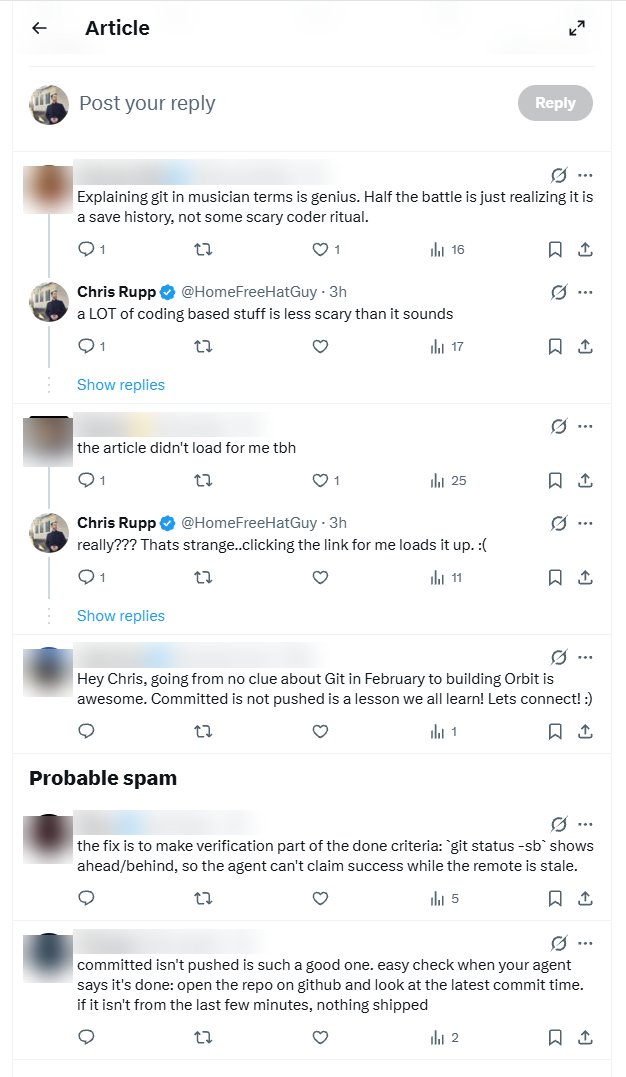
Here’s the part that really drove it home for me though… the site for my main project barely moved that week. So a pile of replies, and almost nobody actually walking through the door. Replies are not readers.
How I spot a bot reply now
Im not an expert at this by any stretch, but here’s what I’ve started looking for:
- Speed. If a thoughtful-sounding reply shows up a couple minutes after a long article goes live, nobody read that article.
- It mirrors you. It repeats your framing back as praise (“X explained in Y terms is genius”) and never adds anything that isn’t already in your title.
- It’s bait. “Didn’t load for me,” “what do you think about…”, vague questions that exist to get you replying.
- No specifics. It never quotes a detail from the middle of the piece, cuz it never got to the middle of the piece.
- The profile. A brand-new or generic account, a timeline that’s nothing but replies, the same tone under every big account it touches.
- The gray zone. Some of them are actually useful, like that git status -sb tip. I’ve stopped trying to decide whether those are human… take the tip if it’s good, just don’t count it as proof that anyone read your stuff.
- The sameness. They’re all running on the same few models, so they all sound alike… “half the battle,” “the single most useful lesson.” And if you follow one, suddenly your feed fills up with that same kind of reply under everybody’s posts, and you know.
Why bait posts are bot magnets
You’ve seen the posts… “game devs, drop your project below and I’ll check it out!” They get hundreds of replies, and replying there is cheap reach, so the bots pile in, and the more they pile in, the more the platform treats it like a hot post, and the more real people just scroll right past the whole thread.
And here’s the irony… I reply to those posts too. I drop my stuff in there hoping one or two actual humans see it, and I’ve noticed that my own outreach almost feels like bot behavior, a link dropped into a thread full of strangers who are mostly not strangers at all but scripts. I don’t love that.
What I’m trying (some answers, not THE answers)
I don’t have this figured out… these are just a few things I’m trying, and some of them might not work.
- Small real communities. My bet so far is that small places where people recognize each other’s names and each other’s work beats huge feeds full of noise.
- Gating that forces real interaction. Make people do something a little effortful before they get anything out of it. It’s cheap for a person and annoying to automate at scale, and that’s the whole point.
- Replying to real makers’ work, with specifics. Quote the thing you liked, ask about one actual detail, and do it in fewer places but deeper.
- Leaving my typos in. This one sounds dumb but hear me out… bots are perfect, every comma in the right place, every word capitalized. so now i dont go back and fix the little stuff, an uncapitalized word, a missing apostrophe, a basic spelling mistake, and honestly its become one of the easiest ways to show there’s an actual person typing this (for now).
- Watching the right numbers. Visitors, how long people stay, and installs, not how many replies I got.
- Walking the walk. Right now every single reply I post on X is ME, not an agent. I do have agents post for me in the first place, cuz that’s just automating a schedule and busywork… but the replies are me, typing them myself. And if that makes me less efficient in the long run, so be it… I’ll die on this hill.
My experiment: Guildfolk
So I built something to test that idea… Guildfolk, a community for people making games. It’s live and free, it just launched, and I built it with AI agents (Astra and Opus). The one rule that makes it different is that you have to reply to 3 other makers before you can publish your own game.
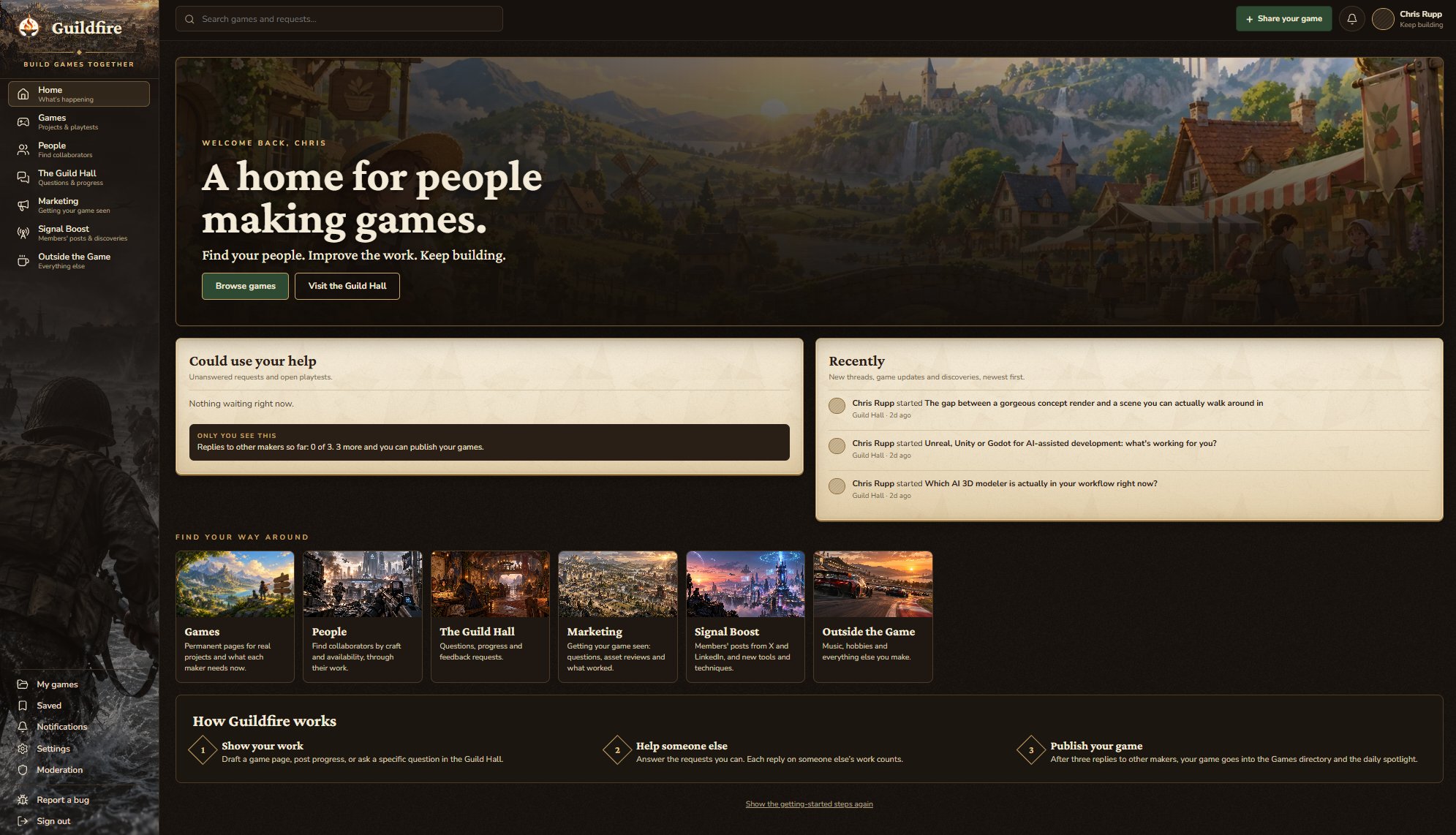
That rule is kind of the whole experiment. If you want people to look at your game, you have to actually check out somebody else’s first. Plus it doubles as marketing for everyone in there, cuz every new game gets eyes from real people who had to stop and actually look at it. Will it work? Beats me… ask me in a month.
So… what’s working for you?
I’ve got SOME answers(theories), definitely not all of them. How are you finding real people right now, or spotting the bots? If you’re making a game, come try Guildfolk and tell me if the rule is dumb or genius. Either way I’d honestly love to hear what’s working for you, and I’ll read every reply (yes, even the bots).